
Kyubey’s Trial
Play the Game: Kyubey’s Trial
Brief:
“As a team create a board game for 5 players.”
About the game:
Group prototype
Team Size: 4
Time to complete: 1 month
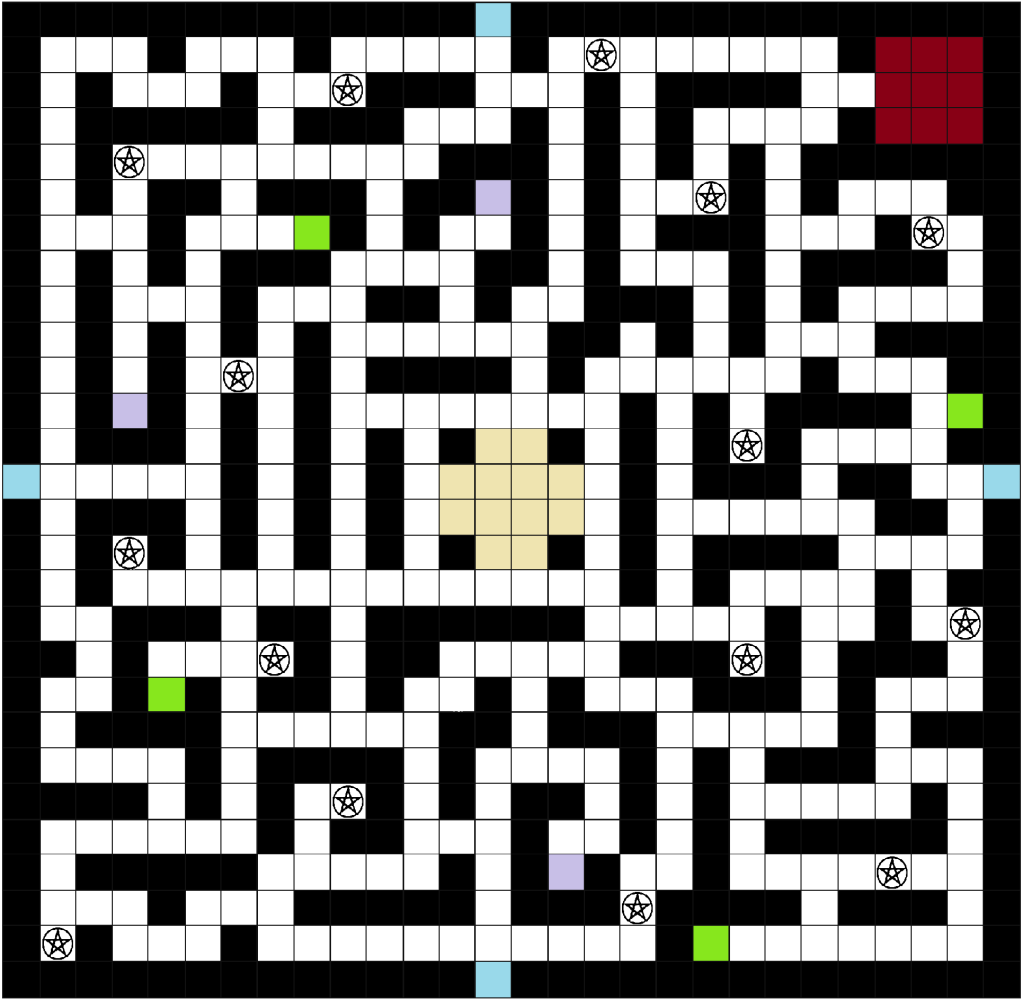
This project is a five-player asymmetrical board game where four survivors attempt to escape an enchanted forest while a single opposing player takes on the role of a witch trying to stop them. The survivors must activate protective runes while managing limited resources, while the witch uses unique abilities to disrupt their progress.
The game was designed to encourage tension, cooperation among survivors, and direct opposition between player roles.
My Role and Contributions:
- Created the initial game concept during early team brainstorming
- Designed the game map and overall board layout
- Prototyped multiple iterations of the map and refined it through four versions
- Led the initial rule design and worked with the team to refine and balance mechanics
- Observed and documented player behaviour during three structured playtesting sessions
- Collected and analysed feedback to inform rule adjustments and layout changes
The map design and rule structure were central to how players navigated space, created tension, and interacted with one another.
Design Focus:
The core design focus was asymmetry. Survivors were designed to rely on cooperation, planning, and limited-use items, while the witch player was given disruptive abilities that created pressure and uncertainty.
The board layout was designed to support these dynamics by controlling movement, line of sight, and player interaction, ensuring that neither side had a dominant advantage without strategic play.
Playtesting and Iteration:
Three playtesting sessions were conducted with external players. Feedback focused on pacing, clarity of rules, and balance between the survivor and witch roles. Iterative changes were made to the board layout and rules to improve flow and reduce confusion.
Playtesters consistently described the game as engaging and tense, validating the core concept while highlighting opportunities for further depth.
Reflection and Future Improvements:
This project was my first experience working on a collaborative game design outside of a digital environment. It reinforced the importance of communication, iteration, and observation when refining mechanics.
If expanded, I would introduce unique player abilities to further differentiate survivor roles and add strategic depth. This would encourage replayability and create more varied player experiences without significantly increasing complexity.
 kgaming.online
One Comment Add yours