
Province Rebellion
Play the Game: Province Rebellion
Brief:
“As a team create a board game, without the use of cards.”
About the game:
Group prototype
Team Size: 4
Development time: 3 weeks
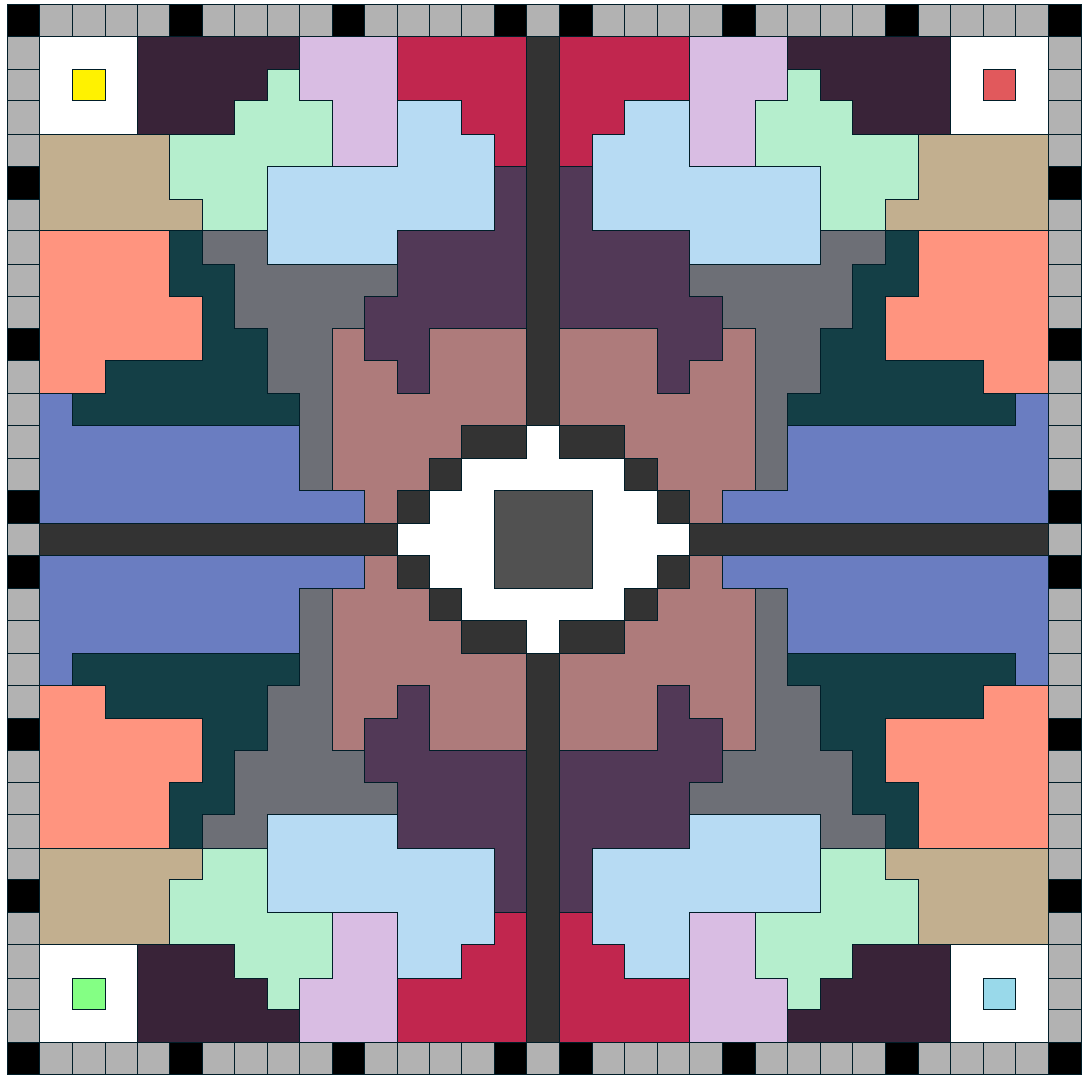
This project is a territory control board game focused on expansion, resource management, and player conflict. Each player begins in a different corner of the board and competes to claim provinces while building an army capable of taking control of the central kingdom.
The game supports multiple play modes, including one versus one, two versus two, and free-for-all. Victory conditions vary depending on mode, either through full territorial control or by capturing the central kingdom.
My Role and Contributions:
- Developed the initial game concept during early brainstorming
- Designed and prototyped the game map and territory layout
- Finalised the board design after team review and iteration
- Led the initial rule design and worked collaboratively to refine mechanics
- Observed and documented player behaviour during three structured playtesting sessions
- Collected and analysed feedback to inform rule clarity and balance adjustments
The map design played a key role in shaping player interaction, pacing, and strategic decision-making.
Design Focus:
The core design focus was territory control and player choice. The board layout was designed to encourage conflict between players while offering multiple routes toward expansion. Starting positions in opposing corners created early strategic divergence and ensured that no single player had an inherent advantage.
Removing cards from the design placed greater emphasis on board state, positioning, and rule clarity, requiring systems that could be understood and tracked directly through play.
Playtesting and Iteration:
Playtesting revealed that early versions of the game were difficult to understand without careful explanation. Through iteration, rules were clarified and adjusted to reduce friction while preserving strategic depth.
Feedback helped identify opportunities to streamline complexity, such as reducing rule overhead by embedding key information directly into the board or components.
Reflection and Future Improvements:
This project highlighted the importance of clarity and accessibility in systems-heavy games. While the game functions as a complete experience, further refinement could improve approachability by simplifying rules and reducing reliance on reference material.
If revisited, I would prioritise integrating key values, such as army requirements, directly into the board design to improve readability and ease of play.
 kgaming.online