


Play the Game: Full Throttle Assault: Carnage Over Mayhem
Brief:
“Create any type of game of your choosing, based on your teams strengths. ”
About the game:
Final group project
Engine: Unity
Language: C#
Team Size: 3
Development time: 5 months
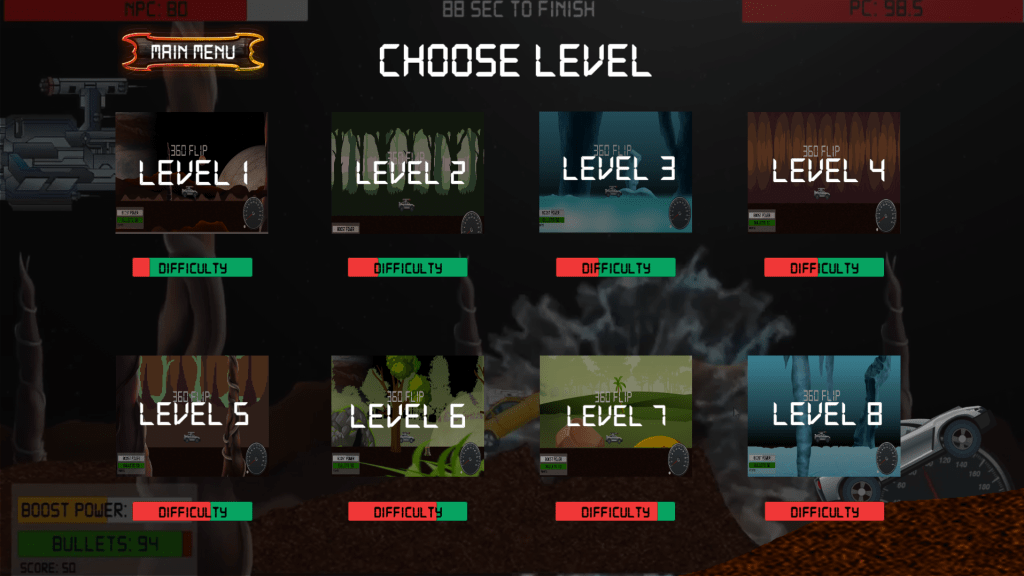
Full Throttle Assault: Carnage Over Mayhem is a 2D action racing game that combines combat, survival objectives, and procedural elements. The game features varied objectives such as point collection, enemy avoidance or elimination, survival challenges, and boss encounters. Levels are set across diverse environments, including hills, icy plains, and off-world locations, with auto-generated layouts, pickups, and traps to encourage replayability.
The narrative frames the game around time travel and fractured realities, providing context for varied locations and escalating challenge.
My Role and Contributions:
- Led production planning and task coordination for the team
- Created and maintained the production plan, milestones, and task tracking
- Organised team meetings and maintained documentation using Trello and Discord
- Planned, ran, and documented multiple playtesting sessions
- Analysed playtest feedback and prioritised actionable changes
- Produced core documentation including the game pitch, proof of concept, playtest plans and results, meeting notes, release notes, and post-mortem
When the team size reduced unexpectedly during development, I helped restructure priorities to ensure the project remained achievable and delivered on time.


Design and QA Impact:
Playtesting revealed several key usability issues early in development. One major issue was a lack of onboarding, with players unsure of controls and object interactions. In response, the team implemented a short tutorial that introduced controls and clarified hazards, pickups, and objectives.
Vehicle handling and physics were also identified as ongoing pain points. Through repeated testing and iteration, the mechanics were improved significantly from the alpha build, even though they remained an area identified for further refinement.
My role focused on ensuring player feedback directly informed design decisions and that improvements were tracked, tested, and documented clearly.
Team Collaboration:
This project was a collaboration between game development and story design students. Clear role definition and communication were essential, especially after the team was reduced from five members to three. Establishing a shared production plan and realistic daily task expectations helped the team remain aligned and avoid burnout.
Reflection and Learning Outcomes:
This project strengthened my skills in production planning, communication, and quality assurance within a multidisciplinary team. It reinforced the importance of clear documentation, realistic scoping, and structured feedback when developing larger projects.
If the project were continued, I would prioritise further refinement of vehicle mechanics, additional objectives and levels, and the implementation of social features allowing players to challenge friends.
This experience gave me valuable insight into collaborative game development and the role of production and QA in delivering a cohesive player experience.
 kgaming.online